
What the question actually is
"Are blockchain comics worth buying?" collapses two different questions that deserve separate answers, and most writing on the subject answers neither.
The first is whether a comic that involves blockchain in some way is a good comic. The second is whether buying a token attached to a comic is a sensible thing to do with money. They are not related. A beautifully drawn book can sit beside a worthless token, and a token that holds its price can be attached to a story nobody finishes.
This piece answers the first question, declines the second, and then looks at where the medium plausibly goes from here.
Start with what you are actually buying
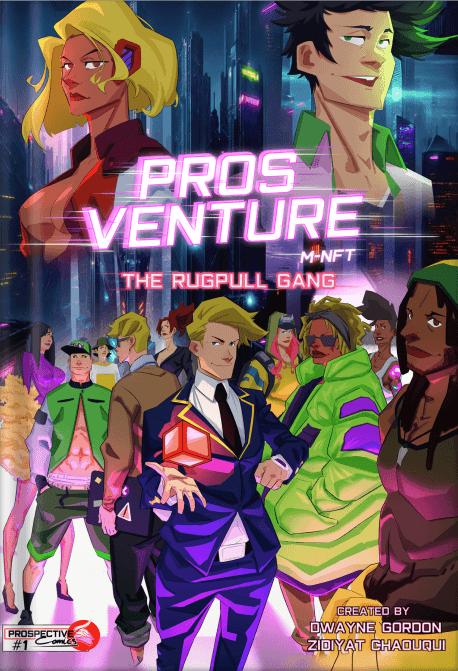
For The Rugpull Gang, the honest answer is unglamorous: a printed comic book. Twenty-four pages, full colour, printed to order and posted to you. The payment is a card payment through Stripe. There is no wallet, no token, and no account required to buy it or to read it.
That matters for a sceptic, because it removes the usual trapdoor. You are not buying exposure to anything. If the book is good you got a good book, and if it is not you got a bad one, and no secondary market is involved in either outcome.
The crypto element in this case is the setting. The story takes place in a world built on a particular financial idea and is interested in what that does to people, in the way a heist film is set in a bank. You do not need an account at the bank to watch the film.
Where the medium has actually got to
Be blunt about the record. The first wave of blockchain comics was mostly a funding mechanism wearing a story as a costume. Projects launched with a roadmap instead of pages, sold tokens on the promise of a book, and a great many of them never shipped the book. Readers who arrived for comics left with a wallet full of art they could not read and a Discord that went quiet.
That is not an argument that the idea is worthless. It is an argument that the sequencing was backwards, and it is the reason a sceptical reader is right to ask what exists before asking what is promised.
The projects still standing tend to share one feature: the comic came first and the technology was asked to do a specific job afterwards, rather than the other way round.
What the future plausibly holds, and what it does not
Three things look genuinely durable.
Provenance. Comics have always had a collector culture built on condition, print runs and first editions, and that culture already runs on paperwork — grading slabs, certificates, registries. A verifiable record of which copy is which is a real answer to a real problem collectors already pay for. It is the least exciting use and the most likely to last.
Direct economics between creator and reader. The traditional pipeline takes a very large cut between the person who drew the page and the person who reads it. Anything that shortens that chain matters to independent creators specifically, which is most of the people making interesting comics. This does not require tokens at all, and the parts of it that work are mostly just better payment rails.
Artifacts that change. This is the one the Prospective universe is built around. An M-NFT is a modifiable artifact — the M stands for modifiable — and how far that modification goes is something the story has deliberately not finished telling. The boxes on every character card are those artifacts, which makes the count on a card an inventory rather than a score.
Whether modifiable collectibles turn out to be interesting or merely novel is not yet settled, and anybody telling you it is settled is selling something.
Two things look considerably less durable.
Speculation as a feature. Every version of "get in early and the floor goes up" has the same shape, and the shape is not a comics business. A story that needs new buyers to stay interesting is not a story, and the moment the pricing is the point, the writing stops being the point.
Utility promised in a roadmap. Access, voting, unlockable chapters, games attached later. These are cheap to announce and expensive to build, and the ratio of announced to delivered across the whole category is poor enough to treat any unbuilt promise as worth nothing until it exists.
So: worth buying?
If the question is the comic, judge it the way you judge any comic. Look at the art, read the first pages, decide whether the cast is one you want to spend time with. The character profiles are public and free and will tell you more in five minutes than any amount of technical explanation.
If the question is a token, this article is not going to tell you it is a good investment, because nobody honest can tell you that and the people who do are not describing comics.
The useful test is simple and it survives every future the medium might have: would you want this if the technology were removed? If the answer is yes, the technology is doing its job. If the answer is no, no amount of it will help.
For what it is worth, that is the test this studio has set itself. The book is a book. You can buy it with a card, read it on paper, and never think about any of the rest.